

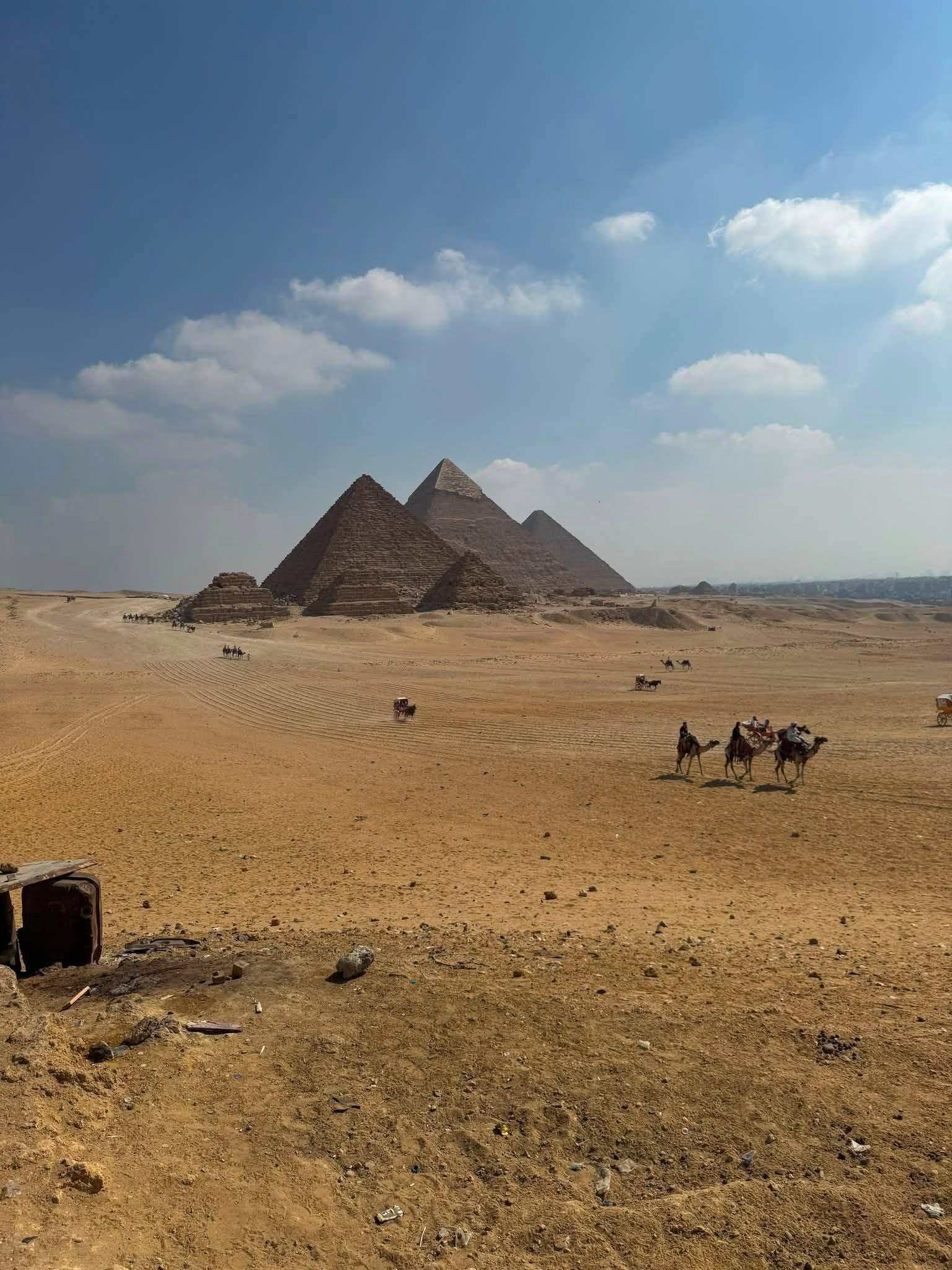
Pyramid of Menkaure
Overview
At the southern end of the Giza Plateau stands the Pyramid of Menkaure, the smallest of the three great pyramids and an important part of Egypt's extraordinary Old Kingdom heritage. Built as the royal tomb of Pharaoh Menkaure during the Fourth Dynasty, this remarkable monument completes the monumental ensemble formed by the pyramids of Khufu, Khafre and Menkaure. For travelers seeking to experience the ancient wonders of Cairo in comfort, a private visit to Menkaure offers an opportunity to explore the Giza Plateau beyond its most famous monument.
The Pyramid of Menkaure originally reached approximately 65 meters in height. While it is considerably smaller than the Great Pyramid, its construction incorporates impressive quantities of granite, particularly in the lower sections. Some of these enormous granite blocks remain visible today, allowing visitors to appreciate the scale and craftsmanship involved in creating a royal funerary monument more than 4,500 years ago.
Menkaure's pyramid was the central element of an extensive funerary complex. A mortuary temple, valley temple and causeway were used for ceremonies connected with the deceased pharaoh and his journey into the afterlife. Archaeological discoveries in and around the complex have helped researchers understand not only the pyramid itself but also the religious traditions and communities associated with the royal necropolis.
A private Giza Pyramids tour allows you to visit Menkaure at your own pace while your personal Egyptologist explains the monument's history, architecture and religious significance. You can compare the three pyramids and understand why their dimensions and construction methods differ. The experience becomes particularly rewarding when combined with the Great Pyramid of Giza, Pyramid of Khafre and Great Sphinx of Giza, creating a complete journey through the royal landscape of ancient Giza.
For travelers interested in museums as well as monuments, the experience can be extended with a visit to the Grand Egyptian Museum, where ancient Egyptian artifacts provide additional context for the civilization that created the pyramids. Giza can also form part of a tailor-made luxury Egypt tour, combining Cairo's archaeological treasures with Luxor, Aswan and an elegant Nile cruise.
A private visit also provides greater flexibility for photography, sightseeing and personal interests. With private transportation and an expert Egyptologist, you can spend more time at the monuments that fascinate you most rather than following a fixed large-group schedule.
The Pyramid of Menkaure may be the smallest of the three great Giza pyramids, but its granite construction, ancient funerary complex and place within one of the world's most recognizable archaeological landscapes make it an essential attraction for any sophisticated journey through Egypt.
Highlights
- Explore the southernmost of the three major Giza pyramids.
- Discover the royal legacy of Pharaoh Menkaure.
- See the impressive granite construction.
- Learn how the pyramid formed part of a larger funerary complex.
- Compare Menkaure with Khufu and Khafre.
- Visit the Great Sphinx during the same private experience.
- Enjoy a dedicated Egyptologist rather than a large-group tour.
- Combine Giza with the Grand Egyptian Museum.
- Add Cairo to a tailor-made luxury Egypt itinerary.
Menkaure's Royal Legacy
Pharaoh Menkaure belonged to Egypt's Fourth Dynasty, the period responsible for some of the country's most ambitious pyramid-building projects.
His pyramid demonstrates that the royal building tradition at Giza continued after the construction of the enormous pyramids of Khufu and Khafre. Its smaller scale did not mean a less sophisticated project; the extensive use of granite presented significant challenges in quarrying, transporting and shaping the stone.
What Makes Menkaure Different?
The most distinctive feature is the combination of limestone and granite. The granite used in the lower sections creates a striking contrast with the limestone construction higher on the pyramid.
Its smaller dimensions also reflect an evolution in royal pyramid design during the later part of the Fourth Dynasty.
Private Experience at Giza
A private tour allows you to explore the pyramid complex according to your own interests. Your Egyptologist can focus on architecture, ancient religion, archaeology or the history of the Fourth Dynasty.
Private air-conditioned transportation can also make traveling between the different monuments of the Giza Plateau more comfortable.
Best Time to Visit
October through April generally offers more comfortable temperatures for exploring the Giza Plateau. Early morning is particularly recommended during the warmer months.